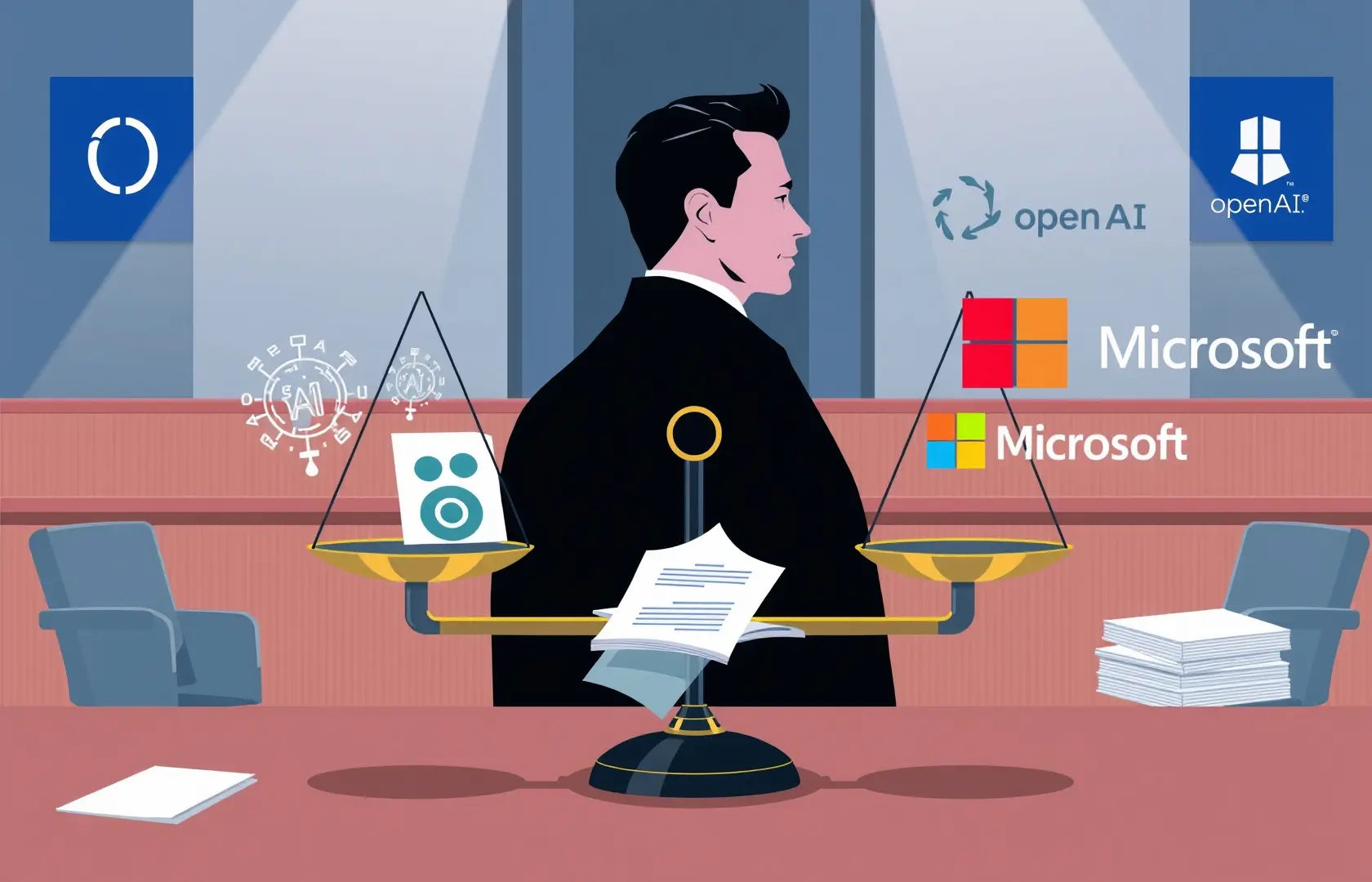
The tech world is currently witnessing one of the most significant legal confrontations in the history of Silicon Valley. Elon Musk, a co-founder of OpenAI who left the organization in 2018, has dramatically escalated his legal battle against the company and its primary partner, Microsoft. In a recent filing, Musk’s legal team has quantified the stakes, seeking damages that range from $79 billion to $134 billion. This staggering figure represents what Musk describes as “wrongful gains” achieved by the defendants after allegedly abandoning the original mission of the artificial intelligence laboratory.
The Billion-Dollar Dispute: Why $134 Billion?
The eye-popping figure of $134 billion is not a random number. According to court documents, Musk’s financial experts arrived at this range by calculating the estimated value of the “wrongful gains” accrued by OpenAI and Microsoft. The core of the argument rests on the idea that Musk’s early seed money and influence were the essential catalysts that allowed OpenAI to reach its current multibillion-dollar valuation.
Musk claims that between 2015 and 2020, he contributed approximately $38 million to the nonprofit venture under the impression that it would remain a “non-profit, open-source” entity focused on developing Artificial General Intelligence (AGI) for the benefit of humanity. The lawsuit suggests that once the technology became valuable, the leadership team—specifically CEO Sam Altman and President Greg Brockman—conspired to monetize the intellectual property for private gain, effectively “flipping” a charitable organization into a commercial powerhouse.
The “Wrongful Gains” Argument
- Seed Funding Value: Musk argues that his initial $38 million investment was the “risk capital” that made everything else possible.
- Intellectual Property: The suit alleges that the advanced models, including GPT-4, are being used to enrich Microsoft rather than serve the public.
- Valuation Arbitrage: With OpenAI recently valued at over $150 billion in private markets, Musk’s team argues that this value was built on the back of his charitable contributions.
From Altruistic Mission to For-Profit Pivot
To understand the depth of this conflict, one must look back at the Musk vs. OpenAI legal history. When OpenAI was founded in 2015, its charter explicitly stated that its goal was to build safe AGI that “benefits all of humanity” and that it would be “unconstrained by a need to generate financial return.”
However, as the costs of computing power skyrocketed, the organization shifted. In 2019, OpenAI created a “capped-profit” subsidiary to attract investment. This pivot allowed the company to secure billions in funding, primarily from Microsoft. Musk contends that this was a fundamental breach of the “Founding Agreement,” a set of verbal and written commitments that he claims formed the basis of his participation.
Currently, OpenAI is in the process of a more radical restructuring, moving toward becoming a Public Benefit Corporation (PBC). This move is designed to make the company more attractive to traditional investors, but critics—including Musk—argue it is the final nail in the coffin of the original nonprofit vision.
The Microsoft Connection: A De Facto Merger?
A significant portion of Musk’s lawsuit is directed at the relationship between OpenAI and Microsoft. Over the last several years, Microsoft has invested more than $13 billion into the AI startup, gaining exclusive rights to integrate its technology into products like Bing, Office, and Windows. Musk’s legal team characterizes this relationship as a “de facto merger,” where OpenAI has essentially become a research arm for the software giant.
The lawsuit claims that Microsoft’s influence has compromised the independence of OpenAI’s board. Musk argues that the technology, which was supposed to be “open,” is now locked behind proprietary walls to serve Microsoft’s bottom line. This partnership has not only drawn the ire of Musk but has also attracted scrutiny from regulators like the Federal Trade Commission (FTC), which is investigating whether such alliances stifle competition in the emerging AI market.
Market Dominance and Antitrust Concerns
The lawsuit explicitly mentions antitrust violations, suggesting that the OpenAI-Microsoft alliance creates an unfair monopoly. By controlling the most advanced AGI models and the massive computing power required to run them, the two companies are accused of creating a barrier to entry that other developers cannot overcome. This is part of a broader trend where major tech players are securing their dominance through strategic AI partnerships and infrastructure deals.
OpenAI’s Defense: “Baseless and Harassing”
OpenAI has not taken these allegations sitting down. The company, led by Sam Altman, has dismissed the lawsuit as “baseless” and “unserious.” In public statements and legal filings, OpenAI has characterized the legal action as a harassment campaign by a jealous former co-founder who missed out on the company’s success.
OpenAI’s defense team has even released internal emails from 2017 and 2018. They claim these documents show that Musk himself suggested that OpenAI needed to raise billions of dollars and that he even proposed a merger with Tesla to provide the necessary resources. According to OpenAI, Musk only turned against the organization when his attempt to take total control was rebuffed by the other founders.
Key Defense Points
- Lack of Formal Contract: OpenAI argues there was never a “Founding Agreement” in the form of a legally binding contract.
- Inconsistent Allegations: The company points to Musk’s own history of suggesting for-profit paths.
- Statute of Limitations: Some legal experts suggest that Musk waited too long to file his claims after the 2019 profit-arm creation.
The Road to Trial: What Happens Next?
As the case moves toward a potential trial, the legal discovery process is expected to be incredibly revealing. Both sides will be forced to turn over internal communications, including emails and board meeting minutes, that could shine a light on the true motivations behind the shift to a for-profit model. If the case proceeds, it could set a massive legal precedent for how non-profit organizations can transition into commercial entities and the rights of early donors in those scenarios.
The outcome of this $134 billion battle will have ripples far beyond the courtroom. It touches on the fundamental ethics of AI development: should the most powerful technology ever created by humans be open to all, or is the “closed” model necessary to fund the astronomical costs of progress? While Musk frames this as a fight for the “soul of AI,” his critics see it as a high-stakes power play in a race for global technological dominance.
Regardless of the verdict, the tension between altruistic research and corporate profit remains the defining conflict of the modern AI era. As OpenAI continues to push the boundaries of what is possible with models like Sora and GPT-5, the shadow of this lawsuit will loom large over every breakthrough.