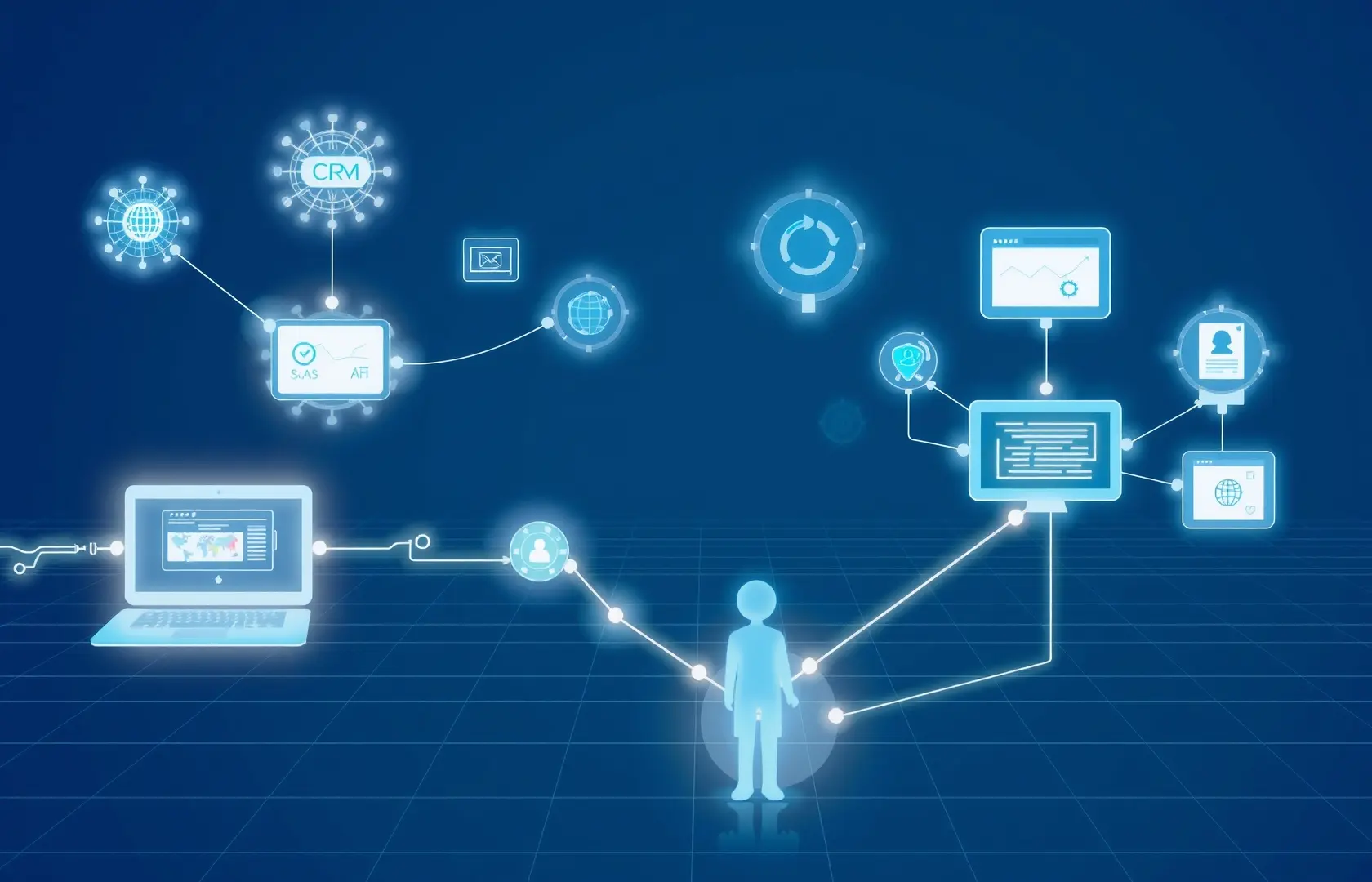
For years, the technology sector has operated under the assumption that software is a tool designed for humans. We log in, click buttons, input data, and wait for reports. However, a seismic shift is underway that flips this paradigm on its head. Instead of humans using software to perform tasks, autonomous AI agents are beginning to inhabit these platforms as “power users,” executing complex workflows without a human ever touching a mouse.
Contrary to early predictions that artificial intelligence would render traditional Software-as-a-Service (SaaS) obsolete, the reality is far more symbiotic. AI agents aren’t “eating” SaaS; they are leveraging its infrastructure, data structures, and established workflows to achieve tangible business outcomes. This evolution is transforming SaaS from a passive record-keeping system into an active, automated playground for agentic intelligence.
The Shift from Passive Tools to Active Participants
The traditional SaaS model was built around the “human-in-the-loop” concept. Salesforce, Slack, and Zendesk were designed to help humans be more productive. But as Large Language Models (LLMs) have evolved into “agentic” systems, their role has shifted from answering questions to taking actions. This is precisely where the value of existing SaaS platforms becomes undeniable.
AI agents require three things to be effective: context, tools, and access. Modern SaaS platforms provide all three. For an agent to resolve a customer support ticket or update a sales forecast, it needs the historical data stored in a CRM and the communication channels provided by a helpdesk suite. Rather than building these complex systems from scratch, AI developers are treating SaaS platforms as the “operating system” for their agents.
We are seeing this play out with major infrastructure shifts. For instance, Anthropic’s recent launch of Cowork demonstrates how agents can be integrated directly into Windows environments to assist with professional tasks, effectively turning standard software into an extension of the AI’s capability.
How Agents Navigate the SaaS Ecosystem
There are two primary ways AI agents are currently interacting with SaaS platforms: through Application Programming Interfaces (APIs) and through direct User Interface (UI) manipulation.
1. The API-First Approach
For most enterprises, the most stable way to let an AI interact with software is via APIs. Platforms like Salesforce and Microsoft have spent decades perfecting their API layers. Agents can “read” a database, “write” a new entry, and “trigger” a workflow almost instantaneously. This allows for high-speed automation that is less prone to the “hallucinations” often associated with visual processing.
2. The UI-Based “Computer Use” Model
The more experimental, and perhaps more disruptive, approach is “Computer Use.” Pioneered by companies like Anthropic, this allows an AI to literally look at a screen, move a cursor, and click buttons just like a human. This is a game-changer for legacy SaaS tools that may not have robust APIs. It enables an agent to bridge the gap between different software silos—copying data from an old spreadsheet, navigating a secure portal, and pasting the results into a modern dashboard.
The Death of the “Seat-Based” Subscription?
As AI agents become the primary users of software, the traditional business model of SaaS—charging per human user, or “seat”—is under immense pressure. If one AI agent can do the work of five junior analysts, a company might only need one “human seat” while the agent performs the rest of the labor. This has forced SaaS providers to rethink their revenue streams.
We are seeing a rapid pivot toward consumption-based pricing and outcome-based models. In these scenarios, a company pays for the number of tasks successfully completed or the amount of data processed, rather than the number of logins. This shift aligns the cost of software directly with the value it provides, a trend that is already being managed by central systems like OpenAI’s Frontier platform, which helps enterprises oversee these sprawling AI workforces.
- Outcome-Based Billing: Paying for a resolved ticket rather than a support agent’s license.
- API Credits: Shifting revenue from the UI to the backend data exchange.
- Agent-specific Tiers: New subscription levels designed specifically for non-human users with higher rate limits.
Security and Governance in an Agentic World
Entrusting AI agents with the “keys” to a company’s SaaS environment introduces significant security challenges. If an agent has the authority to move money in an accounting suite or delete records in a CRM, the potential for catastrophic error or “prompt injection” attacks increases.
Companies are now prioritizing “Agentic Governance.” This involves creating restricted environments where agents can operate with limited permissions. Organizations like OpenAI are working on safety frameworks to ensure that as agents become more autonomous, they remain within the bounds of corporate policy and data privacy regulations like GDPR. The goal is to create a “sandbox” within the SaaS platform where the AI can be productive without posing a systemic risk.
The Future: Vertical AI and the “Thin” SaaS Layer
Looking ahead to 2026 and beyond, the distinction between the “AI” and the “Software” will continue to blur. Industry analysts suggest that we may see the rise of “Vertical AI” companies—startups that build an AI agent designed specifically for one industry (like law or medicine) that comes pre-integrated with all the necessary SaaS tools.
In this future, the SaaS layer becomes a “thin” utility—a reliable database and workflow engine—while the real value lies in the agentic layer that knows how to use those tools to solve problems. SaaS companies that embrace this, providing better “hooks” for AI to latch onto, will thrive. Those that try to block agents to protect their seat-based revenue may find themselves locked out of the next generation of the enterprise stack.
A Symbiotic Evolution
The narrative is no longer about AI versus SaaS. It is about how the most successful companies will orchestrate both. By utilizing the structured environments of SaaS, AI agents are graduating from being simple chatbots to becoming indispensable digital employees. For the enterprise, this means faster execution, lower operational costs, and the ability to scale complex processes at the speed of silicon. The software isn’t going away; it’s just getting a new, much faster set of hands.