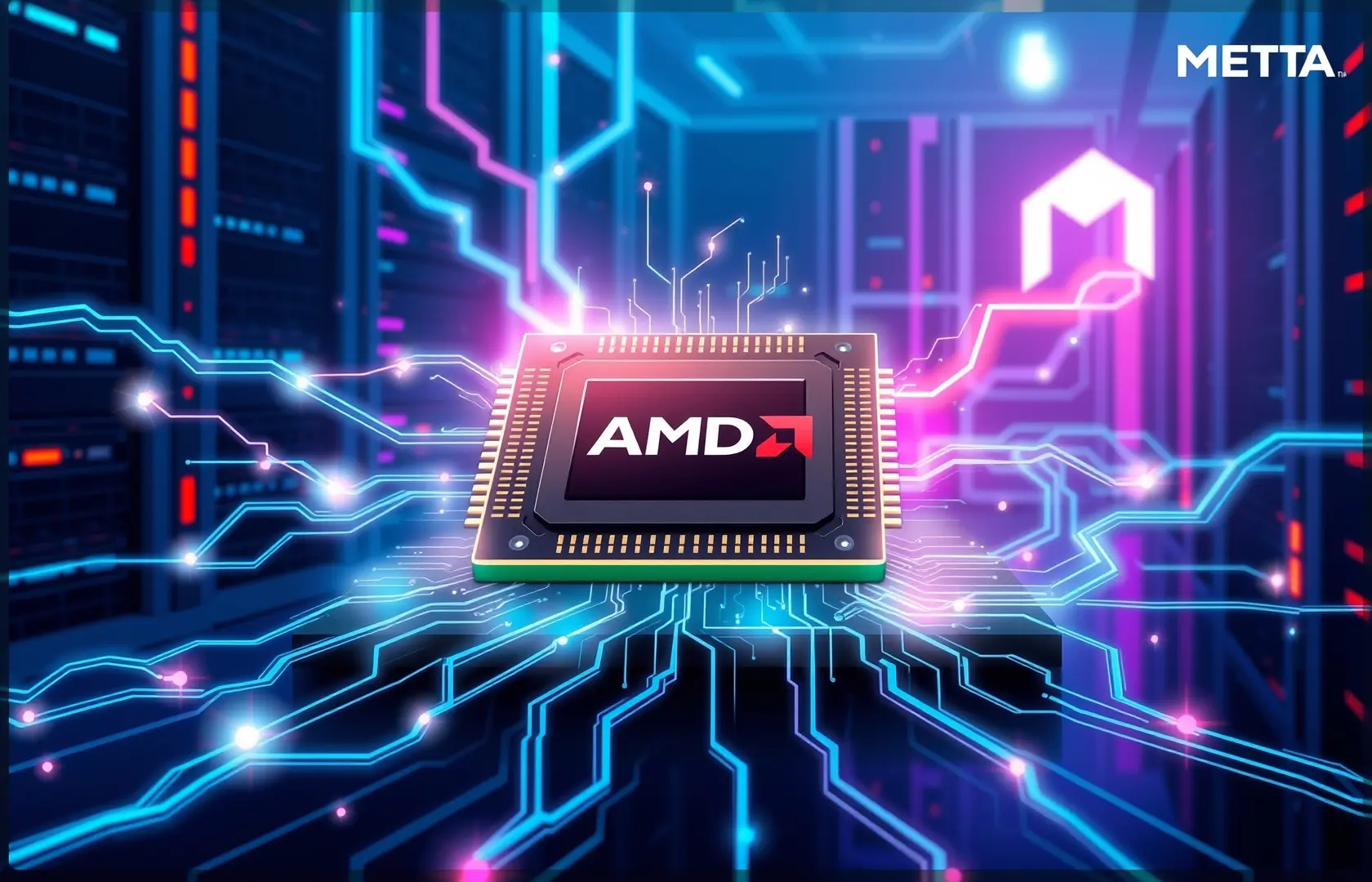
The landscape of artificial intelligence infrastructure has shifted dramatically with the announcement of a multi-year, multi-generation partnership between Meta and AMD. This landmark agreement, valued at an estimated $100 billion, centers on the deployment of a staggering 6 gigawatts (GW) of AI computing power. As Meta continues its aggressive pursuit of artificial general intelligence (AGI), this deal represents a critical move to diversify its hardware supply chain and secure the massive amounts of compute required for its future large language models.
The partnership is not merely a purchase agreement; it is a deep strategic collaboration involving custom silicon and optimized rack-scale systems. By securing such a massive commitment of AMD’s upcoming Instinct GPUs, Meta is positioning itself to maintain its lead in the open-source AI space while reducing its total reliance on a single hardware vendor. This move signals a new era in the AI arms race where the competition is shifting from simple chip availability to full-stack infrastructure optimization.
The 6-Gigawatt Milestone: Scaling AI to New Heights
To understand the scale of this partnership, one must look at the power requirements. A 6-gigawatt commitment is unprecedented in the corporate world. For context, 1 gigawatt can power roughly 750,000 homes. By committing to 6GW of GPU capacity, Meta is effectively building an infrastructure capable of supporting millions of high-performance accelerators. This level of power density is essential for training next-generation models like Llama 4 and Llama 5, which are expected to require orders of magnitude more compute than their predecessors.
The deployment of 6GW of computing power is not a singular event but a multi-year roadmap. Initial phases are expected to begin in the second half of 2026, with the infrastructure scaling through the end of the decade. This long-term visibility allows Meta to design its data centers around specific thermal and power profiles, ensuring maximum efficiency as it builds out its autonomous agents and advanced AI services.
Custom MI450 Architecture: Silicon Optimized for Meta
At the heart of this deal is a new class of hardware: the custom AMD Instinct GPU based on the MI450 architecture. While AMD’s standard MI350 series is already a formidable competitor in the market, the MI450-class chips for Meta will feature specific optimizations tailored to the company’s internal workloads. These “semi-custom” designs typically involve tweaks to the memory subsystem, I/O bandwidth, or specific compute kernels to maximize performance for Meta’s PyTorch-based training environment.
The MI450 is designed to compete directly with Nvidia‘s Blackwell and Rubin architectures. By working closely with AMD on the silicon level, Meta can ensure that the hardware is perfectly tuned for the massive scale of its training clusters. This collaboration reflects a growing trend among “hyperscalers” to seek deeper involvement in chip design to gain an edge in performance-per-watt and total cost of ownership (TCO).
The Helios System and the Open Compute Project
Hardware is only as good as the systems that house it. As part of this win, AMD is also deploying its “Helios” rack-scale AI system. Helios is built upon Meta’s 2025 Open Compute Project (OCP) Open Rack design, emphasizing openness and modularity. This allows Meta to integrate AMD GPUs seamlessly into its existing data center environments without requiring entirely bespoke cooling or power delivery solutions.
The use of OCP standards is a core tenet of Meta’s infrastructure philosophy. By pushing for open standards, Meta ensures that its hardware remains interchangeable and that the broader ecosystem can contribute to the development of better cooling, power, and networking technologies. For more information on how the industry is scaling, visit the Open Compute Project official site. This collaborative approach has historically helped Meta drive down costs and accelerate the time-to-market for new hardware generations.
Strategic Diversification: Moving Beyond the Monopoly
For the past few years, the AI industry has been characterized by a near-total dependence on Nvidia’s H100 and Blackwell chips. This dependency created significant bottlenecks, with companies facing long lead times and high premiums. Meta’s massive deal with AMD is a clear strategic pivot intended to foster a more competitive market. By establishing AMD as a primary, large-scale supplier, Meta gains significant leverage in future negotiations and ensures a more resilient supply chain.
This does not mean Meta is moving away from Nvidia; in fact, Meta recently signed its own multi-year deal for millions of Nvidia GPUs. Instead, Meta is pursuing a “dual-track” strategy. It wants the best of both worlds: the mature software ecosystem of Nvidia’s CUDA and the high-bandwidth memory performance and open-software approach of AMD’s ROCm. This competitive pressure is expected to drive faster innovation across the entire AI era hardware sector.
The Financial Impact: A $100 Billion Investment in the Future
The financial terms of the deal are as massive as the hardware itself. With an estimated value of $100 billion over several years, this is one of the largest single procurement agreements in the history of the semiconductor industry. To align incentives, the deal reportedly includes a stock-based component, allowing Meta to earn warrants for up to 10% of AMD’s outstanding shares based on performance and deployment milestones. This “chips-for-stock” model mirrors similar agreements recently seen between AMD and other major AI labs.
For Meta, the deal is part of a broader capital expenditure (capex) surge. The company has forecasted its 2026 infrastructure spending to be between $115 billion and $135 billion. While these numbers are staggering, Mark Zuckerberg and Meta’s leadership have made it clear that they view AI as the most important long-term investment for the company’s future across social media, the metaverse, and enterprise services.
Key Highlights of the Meta-AMD Deal:
- Scale: 6 gigawatts of total computing power.
- Hardware: Custom AMD Instinct GPUs based on MI450 architecture.
- Systems: Helios rack-scale deployments based on OCP designs.
- Financials: ~$100 billion valuation with a 10% equity warrant structure.
- Timeline: Initial deployments starting in 2H 2026.
Future Outlook: Llama 4 and the Road to AGI
The ultimate goal of this hardware expansion is to power the next generation of generative AI. Meta’s Llama models have become the standard for open-source large language models (LLMs), and maintaining that position requires an ever-increasing amount of compute. With 6GW of AMD power and millions of Nvidia chips on the horizon, Meta will have the capacity to train models with trillions of parameters and advanced multimodal capabilities.
As Meta integrates these systems, the focus will likely shift to agentic AI—models that don’t just generate text but can reason, plan, and execute complex tasks across Meta’s suite of apps. The MI450’s architecture, with its focus on high-bandwidth memory and efficient inference, is particularly well-suited for these “AI agents” that will need to interact with billions of users in real-time. This partnership ensures that Meta has the foundational bedrock required to turn its ambitious AI visions into reality.
In the long run, the Meta-AMD partnership serves as a blueprint for how the world’s largest technology companies will manage their infrastructure. By combining massive capital, custom silicon, and open standards, Meta is not just buying chips; it is building a sovereign AI empire that is resilient, scalable, and highly optimized for the challenges of the next decade.