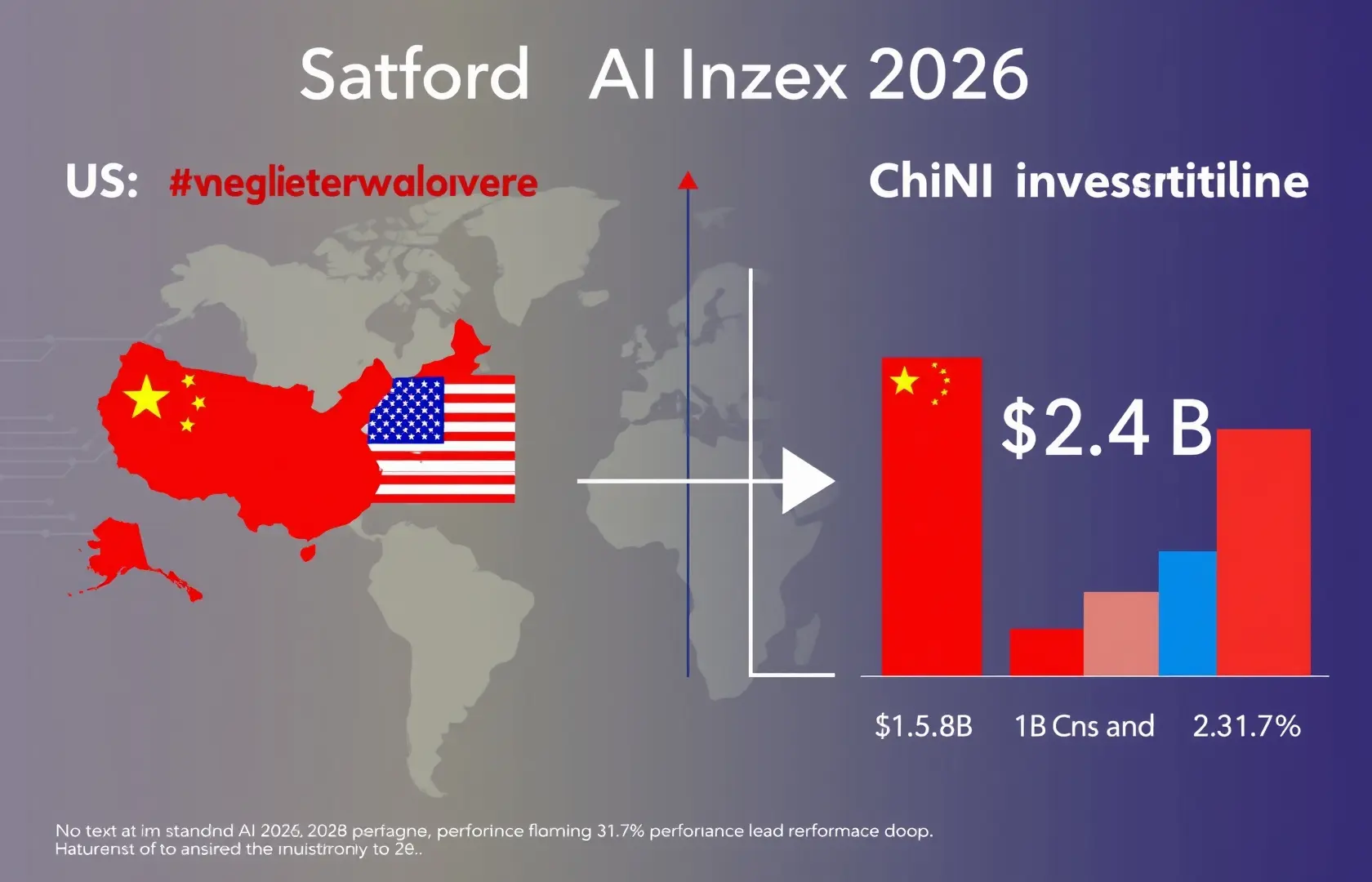
Stanford AI Index 2026: Overview
The latest Stanford AI Index 2026 report reveals a remarkable shift in global artificial intelligence dynamics, especially between the United States and China. While the US continues to dominate in overall AI investment, China has rapidly closed the performance gap in AI capabilities despite spending drastically less.
Key Findings on US vs China AI Progress
- AI Performance Gap Narrowing: The performance lead held by US AI models over Chinese models shrank from 31.6% to just 2.7% in 2026, signaling near-parity in cutting-edge AI model ability.
- Investment Disparity: The United States invested approximately $285.9 billion in private AI developments in 2025, whereas China’s private AI investment totaled about $12.4 billion. This means the US invested over 23 times more than China.
- Model Production and Quality: US institutions released 40 notable AI models in 2024, compared to 15 models from Chinese institutions. However, China leads in AI research publications, patent counts, citations, and industrial deployment metrics.
- Talent Migration Decline: Migration of AI talent to the US from China dropped by 89%, indicating China’s ability to retain and grow its AI expertise domestically.
China’s Strategic Focus and Competitive Advantages
China continues to leverage government-backed industrial policies that foster AI development across the full technology stack, including semiconductor production, AI applications, and deployment infrastructure. The government’s targeted investments and support mechanisms have accelerated AI adoption and innovation despite comparatively limited private funding.
US Leadership and Challenges
The US remains a leader in private AI investment, innovative AI model creation, and overall influence in the AI industry. Nonetheless, the rapidly shrinking AI performance gap with China and the vast difference in investment efficiency raise questions about future competitiveness.
Moreover, widespread concerns about AI safety, ethical standards, and governance are growing globally, with calls for transparent and responsible AI development in both countries.
Global AI Adoption and Impact
The report highlights that AI adoption worldwide is accelerating, with an estimated 53% of the global population using AI-powered tools within three years. This rapid integration is driving significant business uptake and consumer benefits, even when many AI services are offered free.
Despite this progress, the report notes challenges in responsible AI practices, safety incident reporting, and balancing advancement with societal risks.
Conclusion
The Stanford AI Index 2026 underscores a highly dynamic AI landscape where China is closing the gap with the US in performance and innovation efficiency despite vastly different investment levels. Policymakers and industry leaders worldwide must consider this evolving rivalry to foster ethical, competitive, and sustainable AI progress.
For more related insights into AI developments, check OpenAI’s Next Model: Extreme AI Reasoning.