The Shift from Chatbots to Autonomous Agents
The landscape of artificial intelligence is undergoing its most significant transformation since the initial release of large language models. While the early years of the AI boom were defined by chatbots that could generate text and answer questions, the current phase is defined by action. We are entering the era of the AI agent—systems that don’t just talk, but perform multi-step tasks autonomously across digital environments. Two of the most prominent players in this space, Anthropic and Microsoft, have recently unveiled major updates that signal a direct battle for control over the future of work.
Anthropic has officially launched its newest tool, Cowork, a platform designed to turn AI from a single-user chat interface into a shared team infrastructure. Simultaneously, Microsoft is accelerating its AI agent development by pairing new specialized hardware with an expanded developer ecosystem. This dual surge reflects a growing realization: the true value of AI lies in its ability to operate independently within complex corporate workflows.
Anthropic Cowork: Beyond the Chat Window
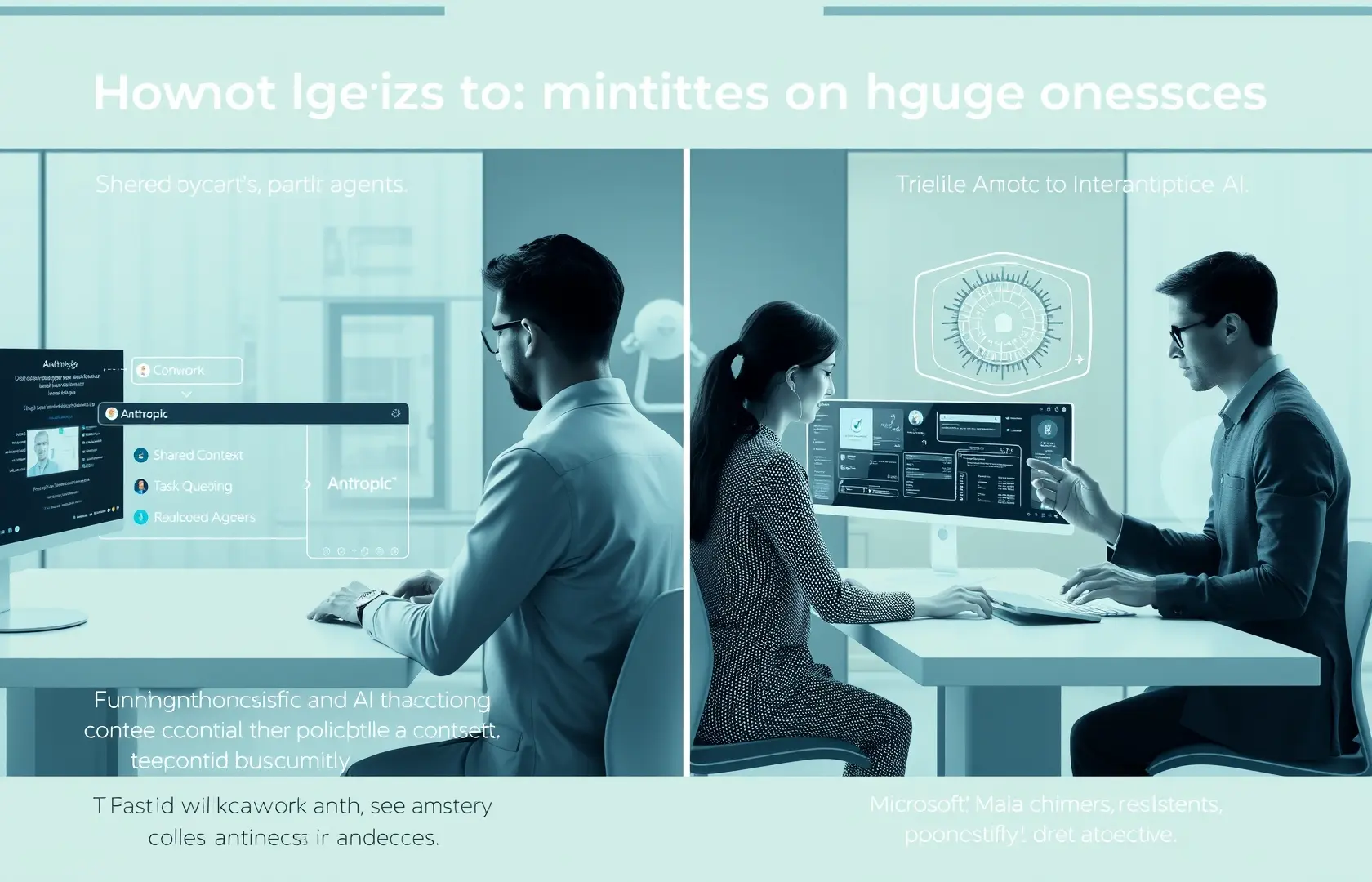
For most users, interacting with AI has been a transient experience. You ask a question, receive an answer, and the session ends. Anthropic aims to change this dynamic with Cowork. Unlike standard interfaces, Cowork is a persistent, shared workspace where files, context, and project goals remain active across multiple sessions and team members.
Agentic Infrastructure for Teams
Cowork is built on the same “agentic” architecture that powers Claude Code, the tool that recently made headlines when top engineers reported that AI now writes 100% of their code. However, Cowork is tailored for general business users—teams in finance, HR, and marketing—rather than just developers. Key features of the platform include:
- Shared Context: Multiple team members can work within the same environment, allowing the AI to understand the full history and nuance of a project.
- Task Queuing: Users can assign multi-step objectives to the AI, such as “Analyze these three quarterly reports and draft a summary for the board,” and the agent will execute those steps in the background.
- Enterprise Plug-ins: Anthropic has introduced a new plug-in system that allows Cowork to connect directly with internal company data and third-party software, significantly expanding what the agent can actually do.
By moving away from the isolated chat model, Anthropic is positioning Claude as a permanent team member rather than a temporary assistant. This strategy focuses heavily on the “Claude Effect”—the perceived superior reasoning and reliability that has helped Anthropic gain significant ground in corporate America.
Microsoft’s Strategic Acceleration: Hardware Meets Intelligence
While Anthropic is focused on the collaborative workspace, Microsoft is taking a full-stack approach to speeding up agent development. The tech giant is no longer relying solely on its partnership with OpenAI; instead, it is building the physical and digital foundations to host the next generation of agents at scale.
The Power of Maia 200 Inference Chips
One of the primary barriers to deploying complex AI agents is the massive cost of inference—the process of the AI running and making decisions. To address this, Microsoft recently unveiled the Maia 200, its second-generation custom inference chip. By moving away from a total reliance on general-purpose GPUs, Microsoft can optimize its cloud for specific “agentic” workloads, reducing latency and cost for enterprise customers.
This hardware push is paired with the Maia SDK, a developer stack that integrates with PyTorch and other popular frameworks. This allows developers to build agents that are optimized for Microsoft’s specific hardware, creating a tightly coupled ecosystem that is difficult for competitors to match. This represents a significant pivot, as we see Satya Nadella’s strategic shift beyond OpenAI to ensure Microsoft controls its own technological destiny.
The Battle for Enterprise Dominance
The competition between Anthropic and Microsoft is not just about features; it is about the philosophy of enterprise AI. Microsoft’s advantage lies in its ubiquity—Windows, Office 365, and Azure are already the backbone of most large corporations. However, Anthropic is successfully marketing itself as the “safety-first” and “reasoning-first” alternative.
Privacy and Data Security
A major hurdle for AI agents in the workplace is the handling of sensitive data. If an agent is going to autonomously manage your email or financial records, the level of trust must be absolute. Anthropic’s Cowork is built with HIPAA-ready infrastructure and enterprise-level deployment controls, targeting industries like healthcare and finance where security is the primary concern. Microsoft is countering this by integrating agentic capabilities directly into its trusted Copilot ecosystem, leveraging decades of existing enterprise security protocols.
Customization vs. Integration
Microsoft’s approach focuses on deep integration. By speeding up agent development, they want to make it easy for a company to turn every employee’s desktop into a hub for multiple agents. Anthropic, conversely, is focusing on the quality of the workspace. They believe that a single, high-functioning collaborative environment like Cowork is more valuable than a fragmented ecosystem of smaller agents scattered across various apps.
Why 2026 is the Year of the Agent
Industry analysts have labeled 2026 as the “Agent Era.” We are moving past the novelty phase where users were impressed that an AI could write a poem or summarize an article. Businesses are now demanding return on investment, which only comes through autonomous productivity. The launch of Cowork and the acceleration of Microsoft’s agent tools represent the realization of this demand.
As these tools exit their research previews and enter full-scale deployment, we can expect to see a shift in how white-collar work is structured. Instead of spending hours on data entry or document cross-referencing, professionals will act as “agent managers,” overseeing a fleet of AI entities that handle the heavy lifting of information processing. The success of Anthropic Cowork and Microsoft’s new agent ecosystem will likely determine which of these two companies becomes the primary operating system for the future of business.
Looking Ahead: The Evolution of Human-AI Teams
The convergence of Anthropic’s workspace-centric approach and Microsoft’s hardware-backed speed marks a turning point. We are no longer just using AI; we are working beside it. The introduction of plug-ins for Cowork and the efficiency gains from Microsoft’s Maia chips mean that agents are becoming more capable of handling the “messy reality” of business operations—dealing with inconsistent data, coordinating between departments, and maintaining long-term project memory.
While the competition is fierce, the ultimate beneficiary is the end-user. Whether through the persistent workspaces of Anthropic or the high-speed infrastructure of Microsoft, the tools available to modern professionals are becoming more powerful, more autonomous, and more essential than ever before.