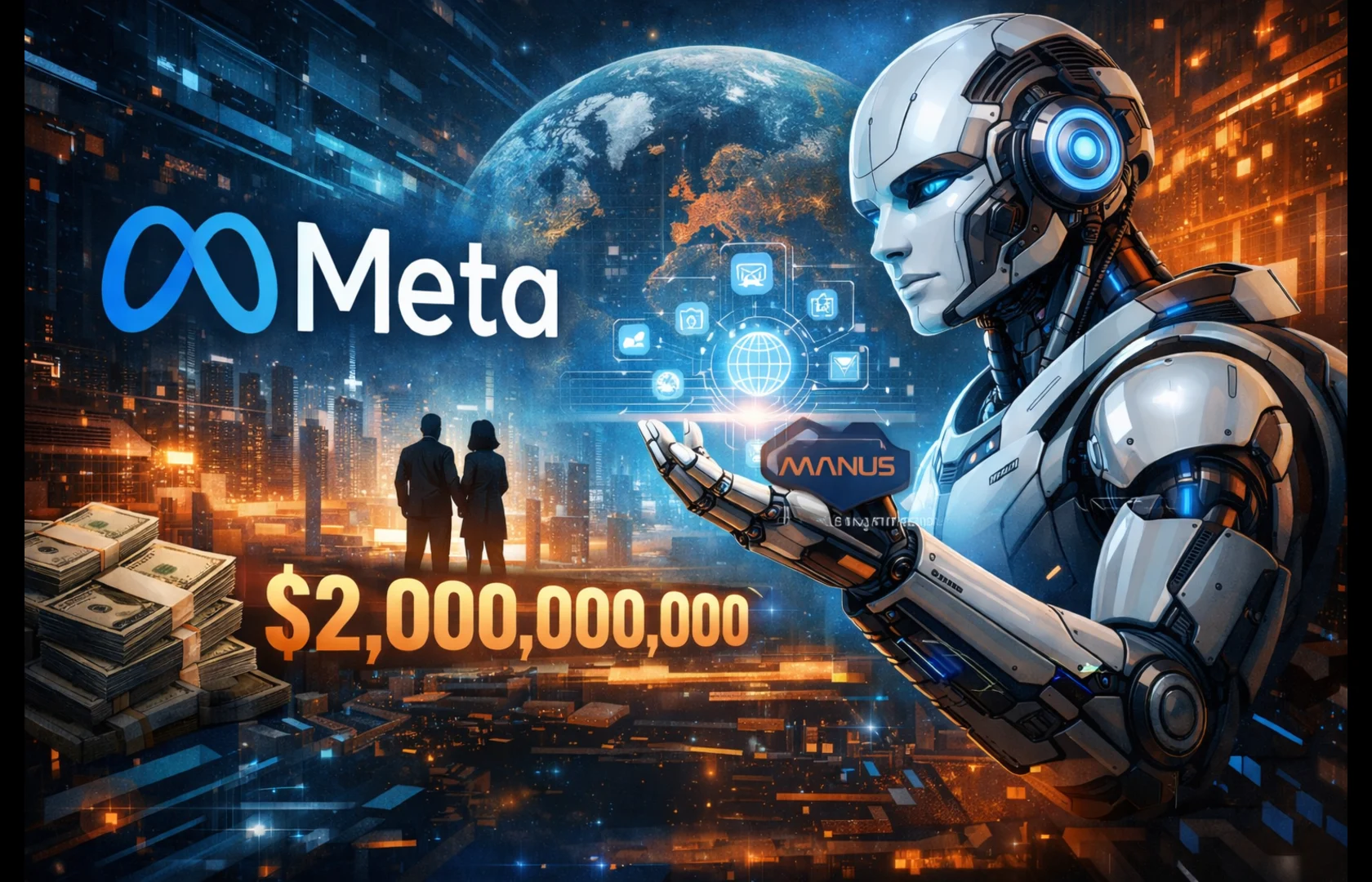
The artificial intelligence landscape just witnessed one of its most significant consolidations to date. Meta Platforms Inc. has officially agreed to acquire Manus, a high-profile startup specializing in general-purpose AI agents, for a sum exceeding $2 billion. This acquisition represents more than just a talent grab; it signals a fundamental shift in Meta’s strategy from developing conversational interfaces to building “agentic” systems that can take independent action on behalf of users.
What is Manus AI and Why Did Meta Pay $2 Billion?
Manus gained rapid notoriety in the tech world as the “action engine” of the AI space. While many LLMs are designed to generate text or answer questions, Manus was built with a specific focus on autonomous task execution. The startup’s core technology allows it to break down high-level human goals into actionable steps and execute them across various digital environments without constant supervision.
According to industry insiders, Manus reached over $100 million in annual recurring revenue in a remarkably short period, proving that there is a massive market appetite for AI that “does” rather than just “talks.” Key capabilities of the Manus platform include:
- Complex Research: Navigating the web to synthesize data from multiple sources into a structured report.
- Autonomous Coding: Building and deploying functional websites and resolving hosting issues.
- Task Automation: Handling administrative burdens such as booking travel, managing calendars, and organizing digital files.
- Workplace Productivity: Integrating into professional workflows to automate cross-platform operations.
The Shift Toward Agentic AI
For the past two years, the AI boom has been defined by chatbots. However, 2025 and 2026 are widely expected to be the years of the AI Agent. An agent differs from a standard chatbot because it possesses the ability to interact with the world—using a browser, filling out forms, and making decisions based on real-time feedback. This transition is often referred to as the move from Large Language Models (LLMs) to Large Action Models (LAMs).
By acquiring Manus, Meta is positioning itself to compete directly with OpenAI’s ChatGPT Agent and similar “Operator” projects designed to take over a user’s computer to complete tasks. Meta’s massive user base across WhatsApp, Instagram, and Facebook provides the perfect laboratory for these agents to scale globally.
Navigating the Geopolitical Landscape
One of the most discussed aspects of the deal is Manus’s origin. Although based in Singapore, the startup has deep Chinese roots and was founded by a team with history in the Asian tech sector. In a rare move for a U.S. tech giant, Meta is reportedly taking aggressive steps to “untangle” the startup from its original Chinese ownership to meet strict U.S. regulatory and security standards.
Meta has stated that all Chinese ownership interests will be removed at closing, and the firm will fully sever ties with any mainland operations. This highlights the growing importance of data sovereignty and security in AI acquisitions, as Western firms remain cautious about the influence of foreign state actors on critical automation infrastructure.
How Meta Will Integrate Manus Technology
Meta CEO Mark Zuckerberg has been vocal about his vision for AI as a universal assistant. The integration of Manus is expected to enhance several key areas of the Meta AI ecosystem:
1. Ray-Ban Meta Smart Glasses
The ultimate goal for wearable tech is a device that can “see” what you see and help you in real-time. Imagine looking at a broken faucet and having your glasses not only tell you how to fix it but also automatically order the necessary part from a local hardware store. Manus’s action-oriented logic is a perfect fit for this vision.
2. Business Messaging
Meta is pushing hard to monetize WhatsApp and Messenger for businesses. Manus agents could allow small businesses to provide 24/7 service that doesn’t just answer FAQs but actually processes returns, checks shipping status, and manages inventory autonomously.
3. The Creator Economy
Creators on Instagram and Facebook could use these agents to automate their research, post-scheduling, and engagement strategies, allowing them to focus more on content production and less on digital administration.
The Competition: A Multi-Billion Dollar Scramble
Meta is not alone in this race. The acquisition of Manus is a direct response to a broader industry trend where every major player is hunting for “agentic” capabilities:
- OpenAI: Developing “Operator,” a tool designed to browse the web and perform tasks on a computer.
- Google: Working on “Project Jarvis,” aimed at automating browser-based workflows within Chrome.
- Anthropic: Recently launched “computer use” capabilities for its Claude models.
The $2 billion price tag reflects the scarcity of mature agentic technology. While many companies can build a chatbot, very few have successfully built an agent that is reliable enough for commercial use. By bringing the Manus team in-house, Meta gains years of R&D and a proven architecture for autonomous decision-making.
Future Outlook: What’s Next for Meta?
As we move into 2026, the success of this acquisition will be measured by how quickly Meta can roll out these features to its billions of users. If Meta can successfully transform the “Manus action engine” into a user-friendly feature within its apps, it could fundamentally change how we interact with the internet. We are moving toward a world where the primary interface with the digital world isn’t a search bar or a news feed, but a personal agent that does the heavy lifting for us.
For investors and tech enthusiasts, the Meta-Manus deal is a clear signal that the next phase of the AI revolution will be defined by utility and autonomy. The days of simply asking an AI to “write a poem” are over; the era of asking an AI to “run my business” has begun.