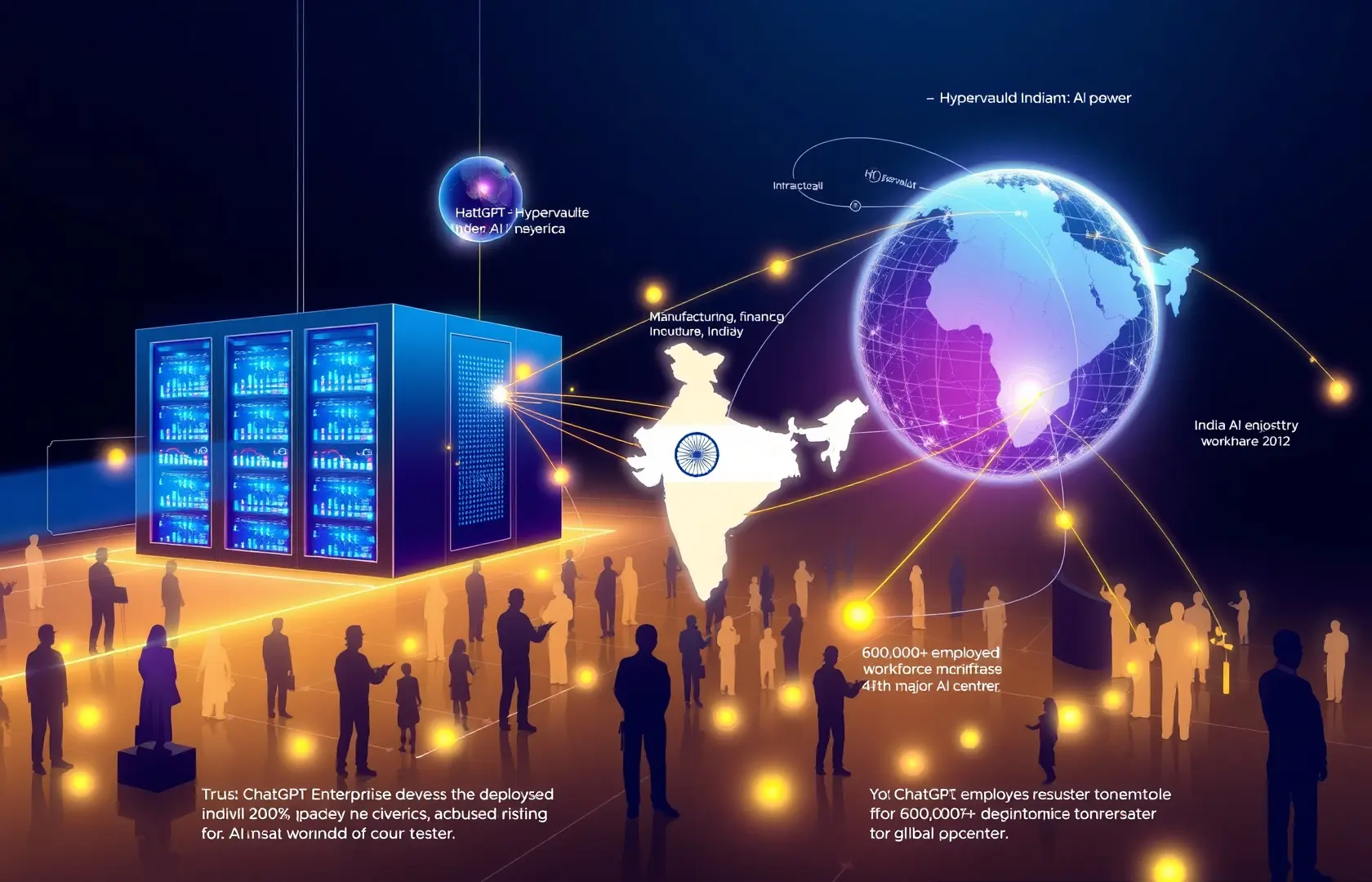
In a move that signals a seismic shift in the global technology landscape, the Tata Group and OpenAI have entered into a foundational partnership that aims to cement India’s position as a dominant force in the artificial intelligence race. Announced at the 2026 India AI Impact Summit, this multi-layered collaboration combines massive physical infrastructure, a record-breaking enterprise software rollout, and a commitment to workforce upskilling that could redefine how large-scale conglomerates operate in the AI era.
HyperVault: The 100MW Engine of India’s AI Ambitions
At the heart of this partnership is HyperVault, a high-density, AI-focused data center initiative led by Tata Consultancy Services (TCS). Initially launching with 100 megawatts (MW) of capacity, the facility is designed with a roadmap to scale up to a staggering 1 gigawatt (GW) in future phases. This project represents one of the most significant capital investments in the history of Indian digital infrastructure, with estimates placing the total expenditure between $35 billion and $50 billion.
HyperVault is more than just a server farm; it serves as a “sovereign AI” hub where data residency and low latency are prioritized for the Indian market. By serving as the anchor tenant, OpenAI will be able to run its most advanced models locally. This localized compute power is essential for sectors like banking, healthcare, and government services, where data sensitivity and regulatory compliance are paramount.
The financial backing for this endeavor is equally impressive. The global asset firm TPG, through its TPG Rise Climate fund, has committed nearly ₹8,820 crore for a 49% stake in the HyperVault business. This partnership ensures that India’s AI growth is supported by sustainable, climate-positive infrastructure, a key requirement for modern high-energy computing.
Empowering 600,000 Employees with Enterprise ChatGPT
While the infrastructure provides the muscle, the deployment of ChatGPT Enterprise to over 600,000 Tata Group employees provides the intelligence. This rollout is officially one of the largest enterprise AI integrations in history, surpassing even the major deals seen in the United States and Europe. Similar to how OpenAI and Snowflake partnered to bring advanced intelligence to data platforms, Tata is integrating AI directly into the workflows of its diverse workforce.
From Tata Motors engineers designing next-generation electric vehicles to Tata Steel floor managers optimizing logistics, the goal is to make AI a daily tool rather than a luxury. The enterprise version of ChatGPT offers several advantages for a conglomerate of this scale:
- Data Security: All interactions remain within the Tata ecosystem, ensuring that proprietary business secrets are never used to train public models.
- Custom Models: Divisions within the group can create “fine-tuned” versions of GPT-4 tailored to specific industry terminologies and historical data.
- Speed and Scalability: Employees gain priority access to the latest OpenAI models without the usage caps found in consumer versions.
The Rise of Agentic AI and Codex in Software Engineering
Beyond standard administrative help, the partnership focuses heavily on software development and Agentic AI. TCS, a global leader in IT services, will integrate OpenAI’s Codex into its engineering pipeline. Codex, the engine behind GitHub Copilot, will help automate complex coding tasks, bug detection, and documentation for thousands of global clients.
The collaboration also targets the development of “Agentic” systems—AI entities capable of completing multi-step tasks autonomously. Unlike a chatbot that simply responds to prompts, these agents can navigate software environments, manage supply chains, and execute complex business processes with minimal human intervention. This aligns with a broader industry trend where OpenAI Frontier acts as a command center for managing vast AI workforces.
OpenAI for India: A Localized Strategy
The partnership also marks a formal expansion for OpenAI within the subcontinent. The organization has announced the opening of new offices in Mumbai and Bengaluru to better support its “OpenAI for India” initiative. This local presence will allow for deeper collaboration with local developers and ensures that Indian languages and cultural contexts are better represented in future model iterations.
Social Impact and the 1 Million Youth Initiative
A central pillar of the Tata-OpenAI agreement is its social mandate. Recognizing the potential for AI to disrupt traditional job markets, the two entities have launched a joint program to train one million Indian youth in AI literacy and specialized technical skills. This initiative aims to prepare the next generation for the “AI-first” economy, focusing on prompt engineering, model fine-tuning, and AI ethics.
Furthermore, the partnership will provide AI toolkits and subsidized access to high-compute resources for Indian NGOs. By democratizing access to these tools, Tata and OpenAI hope to solve local challenges in agriculture, rural education, and public health, proving that AI can be a force for social good in emerging markets.
Geopolitical Significance: India in the Global AI Race
For years, the global AI narrative was dominated by the competition between the United States and China. However, the Tata-OpenAI partnership firmly places India as the third major pillar in this race. By combining India’s vast talent pool and the Tata Group’s diverse industrial footprint with OpenAI’s cutting-edge research, the partnership creates a unique ecosystem that is difficult to replicate elsewhere.
This deal is also a key component of Sam Altman’s “Stargate” strategy—a global infrastructure plan intended to build the massive compute clusters required for Artificial General Intelligence (AGI). By choosing Tata Group as its foundational partner in the region, OpenAI is betting on India’s stability, its growing energy capacity, and its unwavering commitment to digital transformation.
Conclusion: A New Era for Indian Industry
The partnership between the Tata Group and OpenAI is more than just a business deal; it is a blueprint for the future of national industry. Through the construction of HyperVault and the empowerment of 600,000 professionals, Tata is not just adopting AI—it is building the very foundations upon which the next century of Indian innovation will rest. As these two giants begin their journey, the world will be watching closely to see how the combination of Indian scale and Silicon Valley intelligence transforms the global economy.