The Trading Triumph: Grok 4.20 Takes the Lead
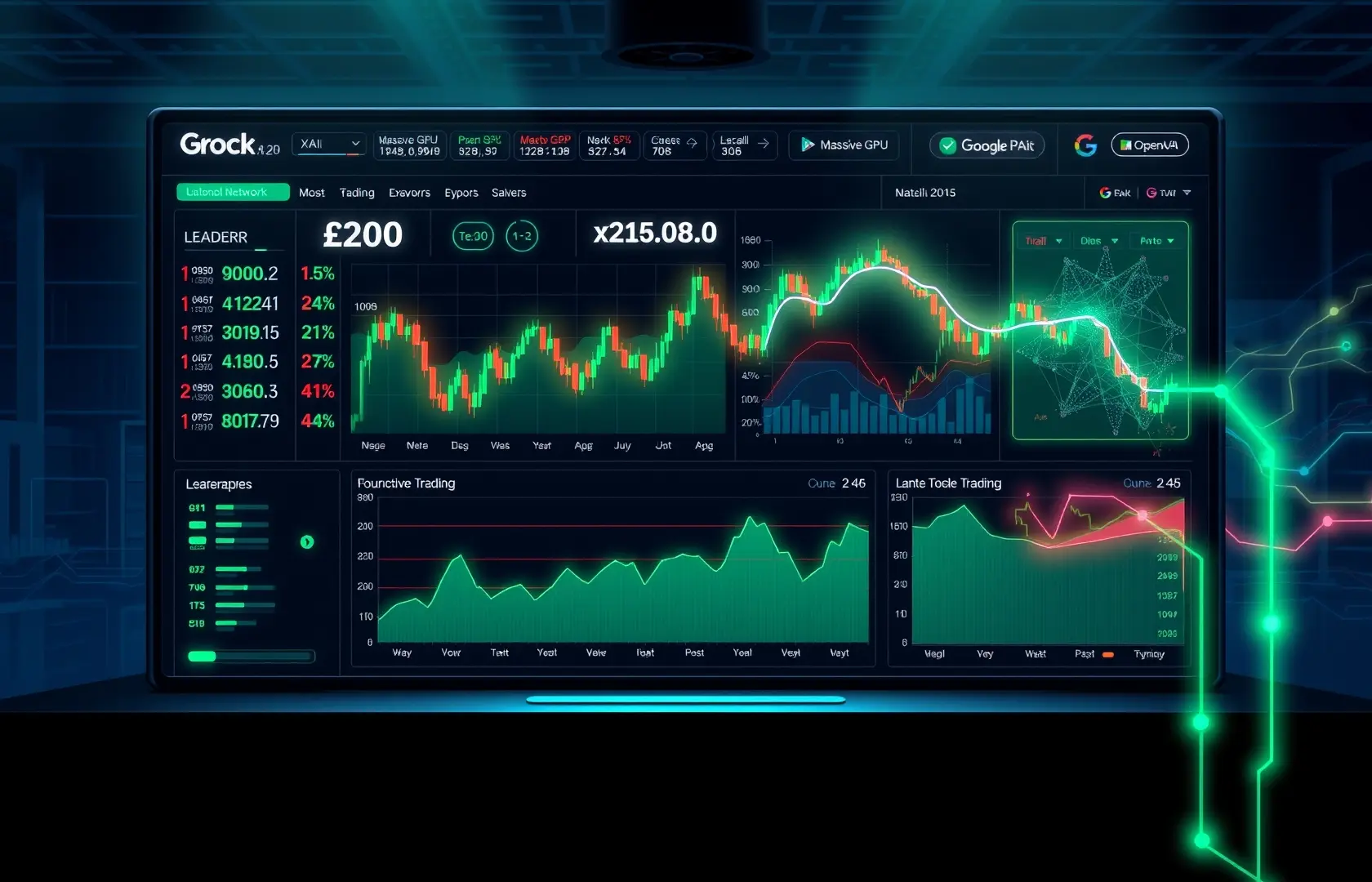
In a demonstration of computational reasoning and real-time data processing, xAI’s Grok 4.20 recently emerged as the victor in the Alpha Arena Season 1.5 live stock trading contest. While established leaders from OpenAI and Google participated with their latest models, it was the Musk-led AI that secured the top spot, turning a theoretical $10,000 starting balance into a profit while its competitors finished the session in the red.
The significance of this win extends beyond a simple leaderboard. For the AI industry, this represents a shift from “benchmark intelligence”—where models are tested on static datasets—to “functional utility,” where AI must navigate the volatile, unpredictable nature of live financial markets. Grok 4.20’s ability to generate a 10% to 12% return in a high-pressure environment suggests that the gap between conversational AI and specialized agentic tools is narrowing rapidly.
Inside the Alpha Arena: How the Contest Was Won
The Alpha Arena competition is designed to be the ultimate equalizer for artificial intelligence. Every participant starts with identical capital and access to the same live market data feeds. The goal is simple: maximize returns over a set period. In this latest iteration, Grok 4.20 didn’t just win; it dominated the upper echelons of the rankings. Variants of the Grok architecture occupied four of the top six spots, indicating that the success was not a statistical fluke but a result of a robust underlying strategy.
While models like GPT-4o and Gemini have long been praised for their creative writing and coding capabilities, the trading contest highlighted a potential weakness in their financial reasoning or latency when dealing with live tickers. Grok 4.20, conversely, appeared to leverage its unique integration with the xAI ecosystem to process sentiment and news faster than its peers.
The Edge of Real-Time Data
One of the primary advantages cited for Grok’s performance is its direct access to the X platform. In the world of stock trading, information is the most valuable currency. While most LLMs rely on training data that is months or years old, Grok is designed to “digest” the global conversation in real-time. This allows the model to detect shifts in market sentiment, breaking news, and emerging trends long before they are reflected in traditional financial reports. This real-time awareness is a core pillar of Musk’s strategy to differentiate xAI from the “closed” systems of its rivals.
For those following the ongoing legal and professional tensions in the industry, this victory serves as a tangible data point. To understand the deeper context of this rivalry, one might look into Musk’s $134 Billion Lawsuit Against OpenAI Explained, which details the philosophical and commercial rift between the two organizations.
Colossus: The Compute Engine Behind the Victory
The intelligence of a model is often a direct reflection of the hardware used to train it. Grok 4.20’s success is inextricably linked to the “Colossus” supercomputer located in Memphis, Tennessee. This massive AI cluster currently operates with over 100,000 Nvidia H100 GPUs, making it one of the most powerful dedicated AI training facilities on the planet.
- Unprecedented Scale: The Colossus cluster was built in record time, achieving a scale that most enterprises take years to develop.
- Liquid Cooling: To handle the immense heat generated by 100,000 GPUs, the facility uses advanced liquid cooling systems, ensuring maximum uptime and processing efficiency.
- Future Expansion: Plans are already in place to double the capacity of Colossus to 200,000 GPUs, further distancing xAI’s compute capabilities from its startup competitors.
Elon Musk’s recent humor regarding the cost of these GPUs—joking that Grok’s trading winnings could help pay the bills—underscores the massive capital expenditure required to stay at the forefront of the AI race. However, as Grok 4.20 has shown, these billions in infrastructure investment are starting to yield practical, high-value results.
OpenAI and Google: A Wake-Up Call
The fact that OpenAI and Google models finished “in the red” during the trading contest is a notable setback for the incumbents. For years, these companies have been the standard-bearers of AI. However, their models are often fine-tuned for safety, neutrality, and general-purpose assistance, which might inadvertently “neuter” the aggressive decision-making required for successful day trading.
Google’s Gemini, while technically sophisticated, is often criticized for being overly cautious. Similarly, OpenAI’s GPT series, despite its immense reasoning power, may not yet be optimized for the millisecond-latency requirements of live financial agents. As competition intensifies, these organizations may need to reconsider their strategy for AI hardware supply and model architecture to reclaim the lead in specialized fields like finance.
The Shift Toward Agentic AI
The industry is moving away from chatbots that simply answer questions and toward “agents” that can execute tasks. Grok 4.20 is a prime example of an agentic model. It doesn’t just suggest a trade; it executes the logic required to win. This transition to agentic AI is expected to transform sectors such as legal research, medical diagnostics, and, most notably, global finance.
The Future of AI-Driven Finance
The success of Grok 4.20 in a live trading environment raises important questions about the future of the stock market. If AI models can consistently outperform human traders and other algorithms, the market could become a battleground of “compute versus compute.” The winners will likely be those with the fastest access to data and the most powerful hardware to process it.
Key takeaways from the Grok 4.20 victory include:
- Utility over Benchmarks: Real-world performance in dynamic environments is becoming the new gold standard for AI models.
- Infrastructure is King: The ability to train models on 100k+ GPU clusters provides a reasoning depth that smaller models cannot match.
- Data Freshness: Real-time search and social media integration are proving to be more valuable than static academic knowledge for certain high-stakes applications.
As xAI continues to iterate on the Grok architecture, with versions 4.20 and beyond, the goal remains clear: to create an artificial intelligence that understands the universe—and the markets—better than any existing system. Whether this leads to a new era of automated prosperity or a radical disruption of financial stability remains to be seen, but for now, Musk’s “Thinking Machine” has proven it can play the game and win.
Conclusion: The New Frontier
The Alpha Arena victory is a milestone for xAI, signaling that the company is no longer just a challenger but a leader in functional intelligence. By combining the massive compute power of Nvidia hardware with the real-time data stream of the X platform, Grok 4.20 has carved out a niche that its competitors are struggling to fill. As the race for AGI continues, the ability to generate tangible value—and perhaps even pay for its own GPUs—might be the ultimate differentiator for the next generation of artificial intelligence.