OpenAI Redefines Autonomous Work with GPT-5.4
The release of GPT-5.4 marks a pivotal shift in the evolution of artificial intelligence, moving from a model that merely answers questions to one that actively executes tasks across a digital environment. While previous iterations relied on API calls or external plugins to interact with software, GPT-5.4 introduces native computer use. This capability allows the model to view a screen, move a cursor, click buttons, and type text just as a human would, effectively turning ChatGPT from a chatbot into a digital coworker.
This release is not just a general update; it is a calculated move into the highly lucrative and demanding world of enterprise finance. By pairing these agentic capabilities with a specialized finance-focused enterprise bundle, OpenAI is targeting regulated industries that require high-precision data handling and complex spreadsheet automation. This strategy aligns with recent reports that OpenAI and Anthropic are clashing to define the standards of the “agentic” era.
The Power of Native Computer Use
The standout feature of GPT-5.4 is its ability to interact natively with an operating system. Unlike previous methods where AI needed structured data or specific integrations, GPT-5.4 can navigate any software interface. It uses “visual reasoning” to interpret what is on the screen and “agentic logic” to determine the next step in a multi-stage process.
Breaking Down Agentic Workflows
- Dynamic Navigation: The model can open a web browser, log into a portal, retrieve a specific PDF, and then enter that data into a legacy accounting system.
- Cross-Platform Execution: It works seamlessly across Windows, macOS, and Linux environments, allowing enterprises to deploy agents across diverse hardware stacks.
- Error Correction: If the AI encounters an unexpected pop-up or a slow-loading page, it can “wait” or troubleshoot the issue, significantly reducing the failure rate seen in early AI automation.
This capability is a direct response to the “computer use” features pioneered by Anthropic. However, OpenAI has integrated this feature directly into the model’s core architecture, theoretically offering lower latency and better reasoning during complex tasks.
Transforming Finance with the Enterprise Bundle
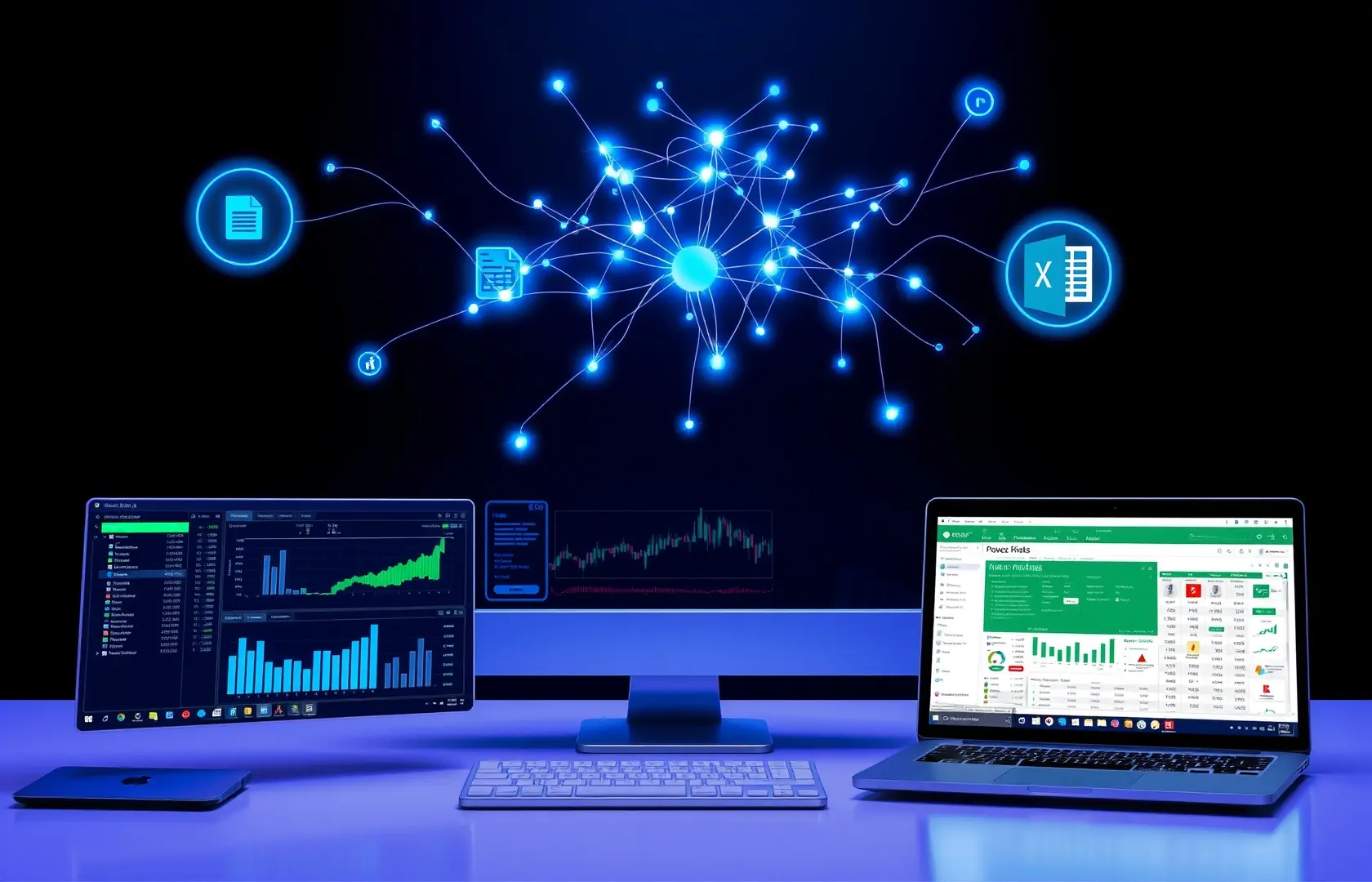
Financial services have long been a challenge for AI due to the need for strict data privacy and the complexity of numerical reasoning. The GPT-5.4 finance bundle addresses these hurdles with a suite of tools designed for investment banking, auditing, and corporate accounting. Central to this is a deeper integration with Microsoft Excel and Google Sheets, enabling the AI to perform “agentic spreadsheet management.”
Instead of just writing formulas, the AI can now build entire financial models from scratch. It can scan years of historical data, identify trends, and generate comprehensive forecasts without human intervention. This move is supported by massive capital backing, as seen in the SoftBank investment in OpenAI, which has helped fuel the infrastructure needed for these compute-intensive tasks.
According to Gartner, over 80% of enterprises are expected to have deployed some form of generative AI by 2026. OpenAI is positioning itself to be the primary provider for the most critical of these deployments—those that handle the core financial health of the world’s largest companies.
Technical Breakthroughs: Context and Thinking
Beyond computer use, GPT-5.4 introduces technical specs that were previously the stuff of science fiction. The model boasts a 1 million-token context window, allowing it to “remember” and analyze massive datasets in a single prompt. For a finance professional, this means the AI can digest a 500-page annual report, thousands of transaction logs, and the current market news simultaneously to provide a unified risk assessment.
Key technical highlights include:
- Chain-of-Thought Reasoning: GPT-5.4 features an “advanced thinking” mode that allows it to pause and verify its own logic before providing an answer, crucial for avoiding “hallucinations” in financial data.
- Real-Time Data Integration: Through its finance bundle, it has direct, low-latency hooks into live market feeds from Bloomberg and Reuters (pending enterprise licensing).
- Privacy-First Infrastructure: The enterprise bundle ensures that all computer-use data and financial inputs remain within a company’s private cloud, never being used to train OpenAI’s public models.
The Future of the White-Collar Workforce
The release of GPT-5.4 signals a new chapter for knowledge workers. While previous AI tools acted as “assistants,” GPT-5.4 acts as a “delegate.” The distinction is vital: an assistant helps you do the work; a delegate does the work for you. In a corporate setting, this could mean an AI agent managing the entire quarterly reporting cycle, from data gathering to final presentation drafting.
As Microsoft continues to integrate these models into the 365 ecosystem, the barrier to entry for high-level automation will vanish. Employees will spend less time on manual data entry and “swivel-chair” tasks—moving data from one app to another—and more time on high-level strategic decision-making.
However, this shift also brings questions about the future of entry-level roles in finance and tech. If an AI can perform the work of a first-year analyst more accurately and in a fraction of the time, the traditional “career ladder” may need to be entirely redesigned. Industry leaders and educational institutions must adapt to this “agentic reality” to ensure the workforce remains relevant in an AI-driven economy.
Conclusion: A New Operating Paradigm
OpenAI’s GPT-5.4 is more than just a software update; it is a declaration that the future of computing is agentic. By giving AI the “hands” to use a computer and the “brain” to understand complex finance, OpenAI is moving closer to its goal of creating a general-purpose digital workforce. For businesses, the choice is no longer whether to adopt AI, but how quickly they can integrate these autonomous agents into their core operations to stay competitive in a rapidly evolving landscape.