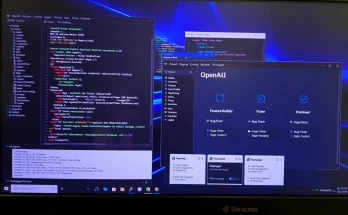
The Shift from Generative to Agentic AI
The global technology landscape is undergoing a fundamental transformation, moving beyond the era of simple conversational chatbots toward a future defined by agentic AI. While early large language models focused on generating text and images, the current wave of innovation centers on autonomy—systems that can plan, execute, and troubleshoot complex tasks without constant human intervention. Leading this charge in the East is Alibaba, which recently unveiled its OpenClaw mobile application, a strategic move designed to democratize access to autonomous AI agents for both developers and casual users.
This development is not just a software update; it represents a significant pivot in how digital ecosystems operate. Unlike traditional apps that require manual navigation, agentic systems act as digital employees capable of coordinating across multiple platforms. This mirrors broader industry moves, such as recent advancements in agentic AI that aim to revolutionize how enterprises manage their daily workflows. By lowering the barrier to entry with a dedicated mobile interface, Alibaba is positioning itself as the primary infrastructure provider for the next generation of automation.
What is OpenClaw? Inside the JVS Claw App
The core of this new initiative is the JVS Claw app, a mobile-first interface for the OpenClaw platform. OpenClaw is an open-source framework that allows users to deploy AI agents that can perform real-world actions. Whether it is booking a flight, writing and testing code, or managing complex e-commerce logistics, these agents are designed to “act” rather than just “talk.”
No-Code Accessibility
One of the most disruptive features of the OpenClaw app is its accessibility. Previously, deploying an autonomous agent required significant technical expertise in Python and API management. The new mobile app allows users without coding skills to install and deploy agents within minutes. By using intuitive “low-code” templates, a user can instruct an agent to monitor price drops on specific products or automate their social media presence directly from their smartphone.
Scalability and Infrastructure
For more advanced users, the platform integrates deeply with Alibaba Cloud infrastructure. This allows for “Team Edition” deployments, where multiple AI agents—such as a virtual developer, a tester, and a project manager—can collaborate in a private environment. This scalability is essential for scaling autonomous systems in corporate settings, where task decomposition and progress tracking are critical for success.
The “Raising Lobsters” Phenomenon: China’s AI Frenzy
In the Chinese tech community, a unique slang term has emerged to describe the rapid deployment of these agents: “raising lobsters.” This refers to the process of “growing” or fine-tuning an AI agent until it is capable of handling complex responsibilities. The “addiction” noted by market analysts stems from the immediate productivity gains these agents provide in a highly competitive digital economy.
- Industrial Efficiency: Manufacturing and logistics firms are using OpenClaw to automate supply chain communication.
- Developer Productivity: Coding agents are taking over the “billable hour” by handling repetitive debugging and documentation tasks.
- Personal Assistants: Users are deploying agents to manage their digital lives, from filtering emails to organizing travel itineraries across fragmented apps.
This frenzy is fueled by the open-source nature of the project. By making the underlying framework available to the public, Alibaba has encouraged a massive grassroots movement. This strategy mimics the early days of the internet, where open standards led to explosive growth and innovation.
The Technical Backbone: Qwen Models and Autonomy
The intelligence driving OpenClaw comes from the Qwen Team, Alibaba’s dedicated research arm. The latest iterations, such as Qwen3-Coder-Next, are specifically optimized for agentic workflows. These models differ from standard LLMs because they are trained with a focus on tool-calling and long-term reasoning.
Agentic reasoning requires the AI to understand that if it encounters an error during a task, it must rethink its approach rather than simply halting. For example, if an agent is tasked with scraping data and hits a firewall, a non-agentic model might just report a failure. An OpenClaw agent powered by Qwen will attempt to find an alternative data source or adjust its parameters to complete the objective.
Agentic Commerce: The New Frontier of E-Commerce
Alibaba is also leveraging this technology to redefine global trade through agentic commerce. In this model, the AI acts as a sophisticated intermediary between buyers and sellers. It can handle end-to-end transactions, including price negotiations, quality verification, and shipping coordination.
For small and medium-sized enterprises (SMEs), this means they can compete on a global scale without a massive administrative staff. An AI agent can respond to inquiries in dozens of languages, manage inventory across different time zones, and even predict demand spikes based on real-time market data. This shift moves e-commerce from a “search and click” model to a “delegate and verify” experience.
Challenges: Privacy, Security, and Governance
As with any breakthrough technology, the rise of agentic AI brings significant risks. Because these agents require deep access to a user’s other apps and sensitive data—such as login credentials and financial information—to function effectively, they are prime targets for cyberattacks.
The Permission Paradox
For an agent to book a hotel, it needs access to your credit card and your calendar. This “permission paradox” is a major hurdle for widespread adoption. Alibaba has addressed this through the HiClaw framework, which emphasizes local deployment and high-security credential management, ensuring that “workers” never have direct access to raw encryption keys.
Regulatory Landscape
Government bodies are also paying close attention. China’s AI regulations are rapidly evolving to cover the “Agent Era,” focusing on accountability. If an autonomous agent makes a financial mistake or violates a service agreement, who is responsible? These questions are driving a new wave of policy debates focused on AI safety and the ethics of autonomous decision-making.
Conclusion: A Future Defined by Digital Autonomy
The debut of the OpenClaw app signals that the age of AI assistants is ending, and the era of AI agents has officially begun. By combining mobile accessibility with powerful open-source models like Qwen, Alibaba is not just feeding a local “addiction” but setting a global benchmark for how humans and autonomous systems will coexist. As these agents become more sophisticated, the focus will shift from how we talk to AI to how we manage the digital teams that work on our behalf. The journey from “generation” to “action” is now well underway, promising a future where productivity is limited only by the complexity of the tasks we choose to delegate.