The Dawn of the Rubin Era: Redefining AI Infrastructure
In a move that consolidates its dominance in the semiconductor landscape, NVIDIA has officially pulled back the curtain on its next-generation AI platform: Rubin. Announced during the CES 2026 keynote, the Rubin architecture isn’t just a minor iteration; it is a fundamental redesign of how the world builds and scales artificial intelligence. With six new chips and a rack-scale supercomputer that dwarfs its predecessors, NVIDIA is signaling a shift toward a world where “agentic AI” and “physical AI” become the standard.
The Rubin platform follows the highly successful Blackwell architecture, but it arrives with a mandate for even greater efficiency. As AI models move from simple chatbots to autonomous reasoning agents, the demand for memory bandwidth and energy-efficient compute has skyrocketed. Rubin is NVIDIA’s direct answer to these challenges, promising a 5x increase in inference performance and a significant reduction in the total cost of ownership for data center operators.
Inside the Silicon: Rubin GPUs and HBM4 Memory
At the heart of the new platform are the Rubin GPUs, which introduce the next leap in high-bandwidth memory: HBM4. This is a critical development because memory bottlenecks—rather than raw processing power—have often been the limiting factor in large-scale AI training. The standard Rubin GPU will feature 8 stacks of HBM4, while the more powerful Rubin Ultra will boast 12 stacks, providing unparalleled data throughput.
Key technical highlights of the Rubin GPU include:
- Tripled Memory Bandwidth: Compared to the Blackwell generation, Rubin nearly triples the memory bandwidth, allowing models to process massive datasets with minimal latency.
- NVFP4 Precision: The introduction of new numeric formats allows for 5x greater inference performance, enabling more complex reasoning within the same power envelope.
- Unified Architecture: The chips are designed to work seamlessly within the AI inference market, ensuring that NVIDIA maintains its lead over specialized ASIC competitors.
Meet the Vera CPU: The Successor to Grace
While the GPU gets most of the spotlight, the CPU is the “conductor” of the AI orchestra. NVIDIA introduced the Vera CPU, the successor to the Grace architecture. Built on a cutting-edge Arm-based design, the Vera CPU features 88 “Olympus” cores. These cores are specifically optimized for the data-heavy workloads required by agentic AI systems that must manage complex logic alongside heavy mathematical processing.
The Vera CPU is more than just a processor; it is part of a “couplet” design. When paired with a Rubin GPU, it forms a high-performance compute tray that can handle everything from real-time data ingestion to the most demanding generative AI training sessions. This tight integration between CPU and GPU is what allows NVIDIA to achieve efficiencies that its competitors, who often rely on third-party CPUs, struggle to match.
The Vera Rubin NVL72: A Supercomputer in a Rack
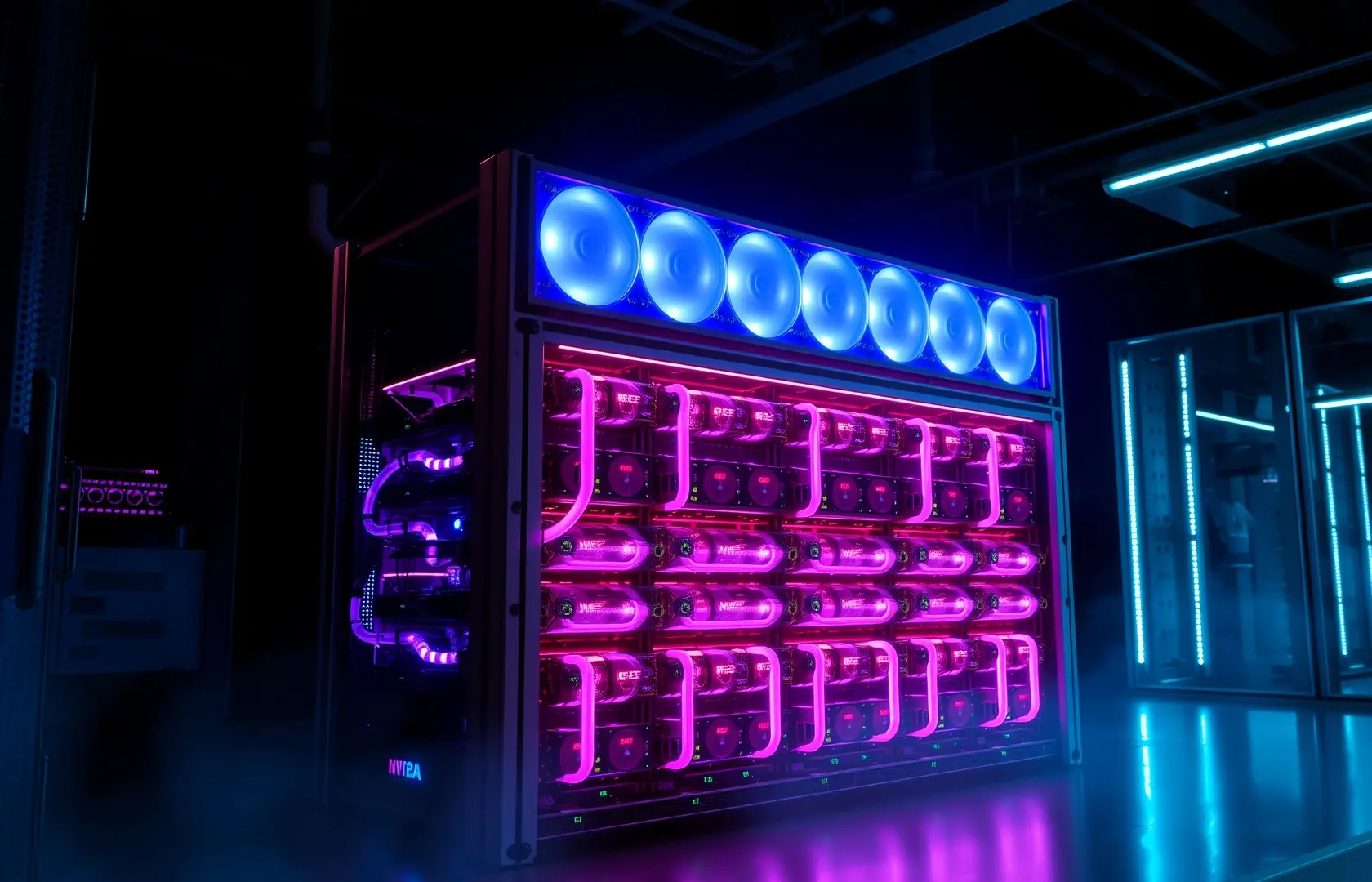
Scaling AI is no longer about individual chips; it is about the system. The Vera Rubin NVL72 is NVIDIA’s flagship rack-scale platform, integrating 1,296 NVIDIA and HBM4 chips into a single, cohesive unit. This supercomputer-in-a-rack is designed to act as a single “giant GPU,” thanks to the next-gen NVLink 6 interconnect, which offers a staggering 3.6 TB/s of total bandwidth.
The NVL72 provides several breakthrough features:
- Massive Memory Pool: The system supports up to 54 TB of LPDDR5X memory, essential for holding trillion-parameter models in an active state.
- Liquid Cooling: To manage the heat generated by 50 PFLOPS (Petaflops) of compute power, the NVL72 utilizes an advanced liquid-cooling system, which also helps reduce energy consumption by up to 10x compared to older air-cooled racks.
- Agentic Reasoning Optimization: The architecture is specifically tuned for “long-thought” processes, where an AI must iterate through multiple steps of reasoning before providing an answer.
Networking at the Speed of Light: Spectrum-X 800 and BlueField-4
As AI clusters grow to include tens of thousands of GPUs, the networking fabric becomes the backbone of the system. NVIDIA’s new networking stack includes the Spectrum-X 800 and Quantum-X 800 platforms, delivering 1.6 Tbps speeds. This is 5x more power-efficient than previous generations, a critical metric as data centers face increasing scrutiny over their environmental impact.
Complementing the switches is the BlueField-4 DPU (Data Processing Unit). Featuring 64 cores, the BlueField-4 handles networking, security, and storage tasks, offloading them from the primary CPUs and GPUs. This “data center on a chip” approach ensures that every bit of Rubin’s compute power is dedicated to AI, rather than administrative overhead. These advancements are a natural extension of NVIDIA’s AI research into integrated infrastructure.
The Shift to Agentic and Physical AI
The timing of the Rubin launch reflects a broader industry trend toward Agentic AI—systems that don’t just generate text but can take actions, use tools, and solve multi-step problems autonomously. By providing the massive memory and low-latency communication required for these “thinking” models, Rubin sets the stage for the next five years of software development.
Furthermore, the architecture is designed with Physical AI in mind. This refers to AI that interacts with the physical world, such as humanoid robots or autonomous industrial machinery. The massive parallel processing capabilities of Rubin allow for real-time physics simulations and sensory processing, making it the ideal “brain” for the next generation of robotics.
What This Means for the Industry
With Rubin, NVIDIA is moving from a two-year release cycle to an annual cadence for its major platforms. This aggressive roadmap puts immense pressure on rivals like AMD and Intel, as well as cloud providers like Google and Amazon who are developing their own custom silicon. By controlling the entire stack—from the GPU and CPU to the networking and software—NVIDIA is creating an ecosystem that is increasingly difficult for competitors to penetrate.
For businesses and developers, the Rubin architecture promises a future where AI is cheaper to run, faster to train, and capable of significantly more complex tasks. As the platform begins shipping in the second half of 2026, we can expect a new wave of AI applications that were previously impossible due to hardware limitations.
NVIDIA’s commitment to pushing the boundaries of Moore’s Law—not just through transistor density, but through system-level innovation—ensures that the AI revolution is only just beginning. The Rubin platform is the foundation upon which the next decade of intelligent systems will be built.